11/20/2018

Mitakuye Oyasin/ We Are All Related


A ceremonial performance at the US Pavilion, La Biennale di Venezia, November 2018
November 24, 2018
La Biennale di Venezia 

US Pavilion courtyard
2:00–3:30p.m.

Mitakuye Oyasin/ We Are All Related was a ceremonial performance centered on healing, finding lost cultural knowledge, and telling the story of climate change through the lens of the Dakota legend of the Wakinyan/ Thunderbirds and Unktehi/ Water Serpent spirits. The epic battle between these supernatural beings is a way of describing the catastrophic effects of climate change through Dakota knowledge.

Moment the sun, Anpa Wi, brings out a rainbow in the battle of Wakinyan/ Thundebirds and Unktehi/ Water Monsters
The power of Dakota language, oral tradition, dance, and creative and artistic processes–which have been obscured through centuries of US policies of genocide and assimilation of Indigenous people–were expressed to call for a profound shift in the evolution of humanity towards a creative, holistic consciousness.


Mitakuye Oyasin, in the context of the "Dimensions of Citizenship" exhibition at Venice Architecture Biennale, is powerful because the concept, which is the basis of Dakota philosophy, holds that we are relatives of not only our families and other people, but animals, plants, rocks, air, electricity, water - which is life itself - and everything in existence, connected by interrelationships in a continuum of life.
sage burner sound vessel

By connecting the concepts of body outward to the cosmos through the sound of the drum, movement, and burning medicines, the ancestors and spirit were invited to the space. My cousin, Adam Genia, an award-winning powwow singer and drummer provided a song which was played on a sound vessel with the sound of a heartbeat.

Pipestone Quarry, on the Coteau des Prairies by George Catlin, 1836-37, Smithsonian American Art Museum

Images of ancient glyphs were drawn on the site of this important US cultural embassy, using a small quantity of canupa/ pipestone pigment.

The Pipestone quarry, located at what is today known as Pipestone National Monument, is a sacred location in Dakota cosmology that is tied to our origin stories.

Photographs, MHS Collection, photoprint: 'Charles H. Bennett removed these rock panels showing pictographs from the Pipestone quarries at the foot of The Three Maidens in the 1880s.'
These petroglyphs from the Three Maidens, an important site at the Pipestone quarry in Minnesota were desecrated and removed in order to be shown in the St. Louis World's Fair. Seventeen of the original 79 petroglyphs made it back to the site, and are now on display at the Pipestone National Monument visitor center.

My daughter drawing petroglyph symbols on the courtyard
When I carve canupa, I save the dust that is a byproduct of the process, as it can be used as a pigment, and, it is so precious that it cannot be wasted. I used some of the pigment to create chalk which my twin daughters and I used to recreate the glyphs looted from Three Maidens on the US Pavilion courtyard site. The images brought indigenous Dakota presence to the site in an unbroken line, at a institution in the tradition of Worlds Fair-type expos, which have had a historically troubled legacy for Indigenous people.

Ancient symbols recreated in pipestone pigmented chalk

To conclude the ceremonial performance, the Wakiyan again took center stage. The Wakinyan love everything that is clean and pure, and they make their tipis by the tallest cedar trees, which is why we use cedar for purification purposes. Using "cedar" sprigs, the audience and I brushed the building in a symbolic act of cleansing the courtyard site of the US Pavilion at the Venice Architecture Biennale, to clear away old energies and make way for new kinds of creative visions to the space.

This piece is in dialogue with  "Acoustic Tipi," which was on site at the Lithuania Pavilion "Swamp Pavilion"

Acoustic Tipi depicts the battle between the Wakinyan and Unktehi, shown here at the closing of the Swamp Pavilion
This program was part of the Citizen Lab programming series and took place in the US Pavilion courtyard.
Check out the Art, Culture and Technology Program at MIT's news piece about the performance here.

9/12/2018

Acoustic Tipi

Photo by Nicolás Kisic Aguirre


Acoustic Tipi
Mahogany, cow hide drums, acrylic, steel hardware, bungee cords, drum sticks
2018
60"x60"x74"
The Swamp School, Lithuania Pavilion, La BiennaleArchitettura di Venezia, Venice, Italy
May - November, 2018
European Cultural Center - Venice, Palazzo Mora
May -November 2019


The tipi sound amplifier is a drum interface which invites people to create audible vibrations that will reverberate through space.


The traditional tipi is a Dakota portable home structure for an extended family, it is a shape of strength. In this piece, the tipi contours have been stylized to encourage sound transmitting capabilities, and it is home to four sacred drums.


drum making


Tightening the skin

Finished natural drums alongside four synthetic drums

Each drum plays a different tone. The drums reside within the structure via tension support cords which enable the sound to be amplified and harmonized, projecting upwards and outwards.


The drums are painted with white, yellow, black and red morningstars, colors of the four directions. The morningstar is symbol of Dakota cosmology and in this context, represents our people and our ways of life that are indigenous to the land. The tipi structure resonates with the pure sound of the drum, directing it down into the ground, each beat a communication to the earth.


The acoustic tipi references unktehi – a supernatural water serpent of Dakota legend, who is responsible for flooding and peril in the water and wakinyan – thunderbeings who bring atmospheric catastrophe, warning of impending flooding, sea-level rise, and the increased intensity of planetary storms due to climate and environmental change.


 At the Lithuania pavilion, at the Venice Architecture Biennale, through the concept of “Swamp Radio (On Transmitting)” we can explore the Venice lagoon as a site for the realization of the interconnectedness of life on earth. Wetland ecosystems occupy a place in between the worlds of the water and the land, teeming with life, and are increasingly threatened by human activity.


Through the sound of the drum, Acoustic Tipi provides an encounter, a moment of reflection, upon the interrelation of life on earth and throughout the universe. The piece allows up to four people to play at once, creating a collaboration which reduces the distance between the art and viewer, and each other. Made from wood which can be easily taken apart and reassembled, its location can change in order to activate different spaces within a built environment and other sites.


Through the power of rhythm, vibrations will reach outward forever into infinity like a synesthetic prayer, creating the possibility of an organic communal experience. The piece is a call for unity to address issues of ecological decline, which, according to Dakota philosophy, is the responsibility of all people.


4/10/2018

InVisible


When worn as a shawl, InVisible provides a symbolic skin of protection against pervasive cultural supremacy. The morningstar form is an expression of cultural power which is used here to transform.

pieced organza
60" x 60"
2017 

Is white cultural supremacy, which expropriates and erases other cultures, a translucent veil so permeating it's nearly invisible to those living under it?

As a Dakota person, I experience cultural supremacy as a tool of the dominant culture that sets itself as the standard, forces assimilation and constantly perpetuates itself to reinforce structures and institutions which maintain a limited picture of reality.
photos by Zach Jama and Gary Zhexi Zhang

The white gossamer fabric of this shawl is nearly transparent, but as it moves, it reflects rays of light in a full spectrum of colors, which affirms its self-possessed strength of presence. It is a reminder that other realities are possible.

3/25/2018

Diaspora & Discord


MDF particle board, ribbon, wire, glass beads, screen printed fabric, 
jingles, dentalium, disco ball motor
30" x 14" x 14"
2017
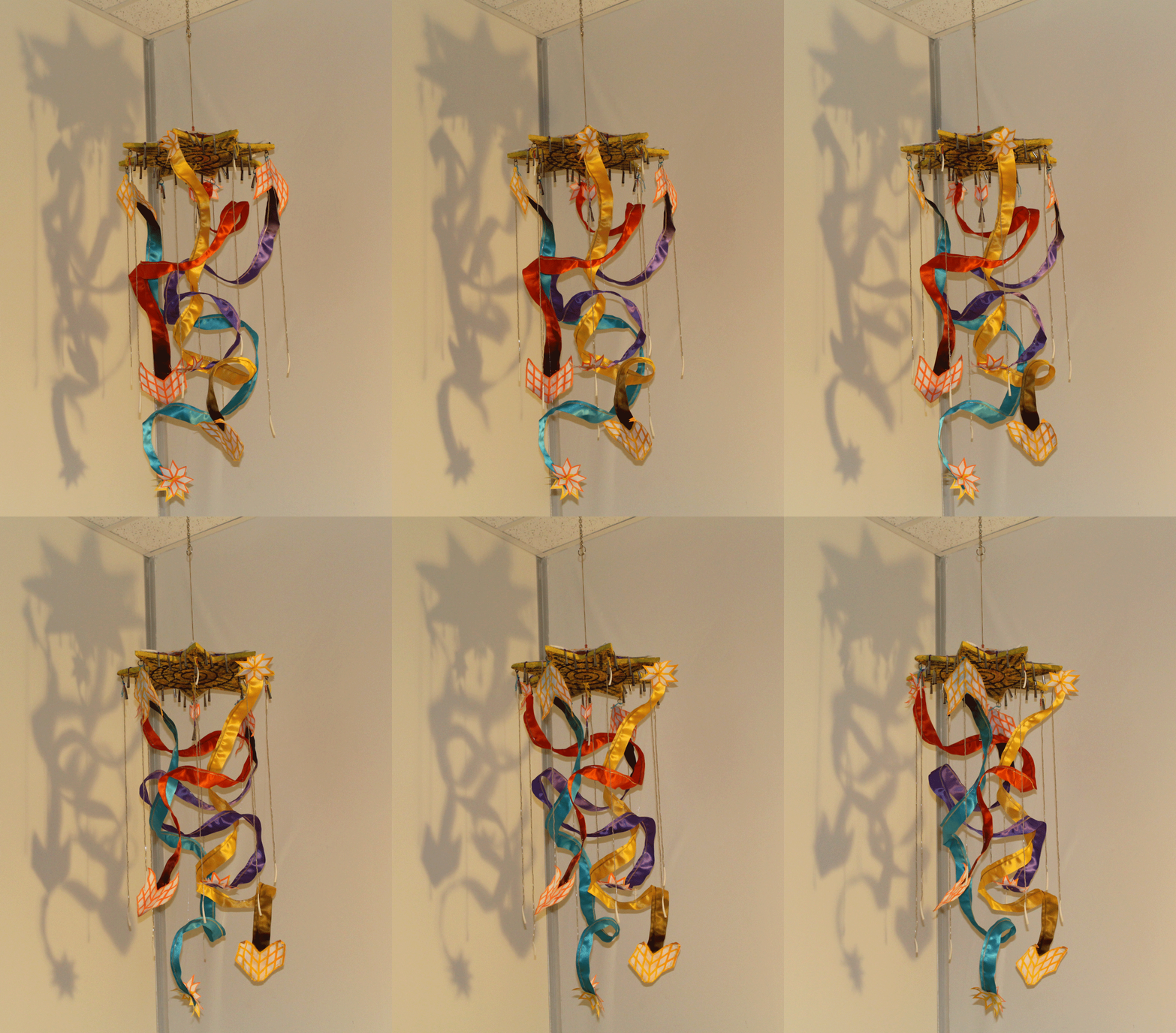
As a Dakota person living in the diaspora that was created as a result of the U.S- Dakota War, I explore the confusing tangle of paths traversed between more than thirty places spanning the Midwest, the Great Plains and into Canada that thousands of Dakota people traveled from 1862 through the 1880s. 


As a mobile structure, the piece engages gravity and the air currents of its surroundings, subtly moving with them. Beginning with a structural form of a Morningstar, four arrows wind around the piece and each other, illustrating back-and-forth paths taken across distance. The arrow’s points are made from silk screened Morningstar forms which have been cut into four pieces, representing our separation in all four directions. The names of the places Dakota people were moved to and from are written upon the base Morningstar form. 

A beaded spiral radiates as the piece rotates, either from wind or the motorized base, signaling disorientation. Ribbons, jingles and dentalium, which I use in creating powwow regalia, come together to form a column of vitality, which shows that, despite our separation and struggle over generations after being forced from our sacred homeland of Minnesota, we do remain a people with our culture. 


In my research, I came across "Dakota Diaspora after 1862" which was published in a 2012 issue of Minnesota's Heritage magazine, created by geographer Robert J. Werner. It maps the places where Dakota people were forced to go between the time of the war and the 1880s, when the creation and settlement of the present reservations and the assimilation period began. I color coded the map, as you can see above, to try to make sense of the routes and to correlate with the arrows in the piece.


The map shows these places where Dakota people were forced to go after the war and displacement and dispossession by white settlers:

Camp Release, Fort Snelling, Fort Totten, Upper Agency, Lower Agency, Mankato, Spirit Lake, Fort Garry, Birdtail Creek, Turtle Mountain, Fort Qu’Appelle, Whitestone Hill, Portage La Prairie, Dakota Tipi, Fort Ellice, Hannibal, Davenport, Saint Joseph, Fort Thompson, Saint Louis, Crow Creek, Killdeer Mountain, Long Plain, Oak Lake, Sisseton Wahpeton, Standing Buffalo, Whitecap, Fort Wadsworth, Wahpeton Sioux, Fort Peck, Niobrara/ Santee, Flandreau, Brown Earth.

Over time the Dakota diaspora has expanded, as the result of mass re-settlement stemming from urbanization caused the Indian Relocation Act, and many other reasons. Still Dakota people agree that Mni sota, today known as the state of Minnesota, remains our homeland and place of origin.